
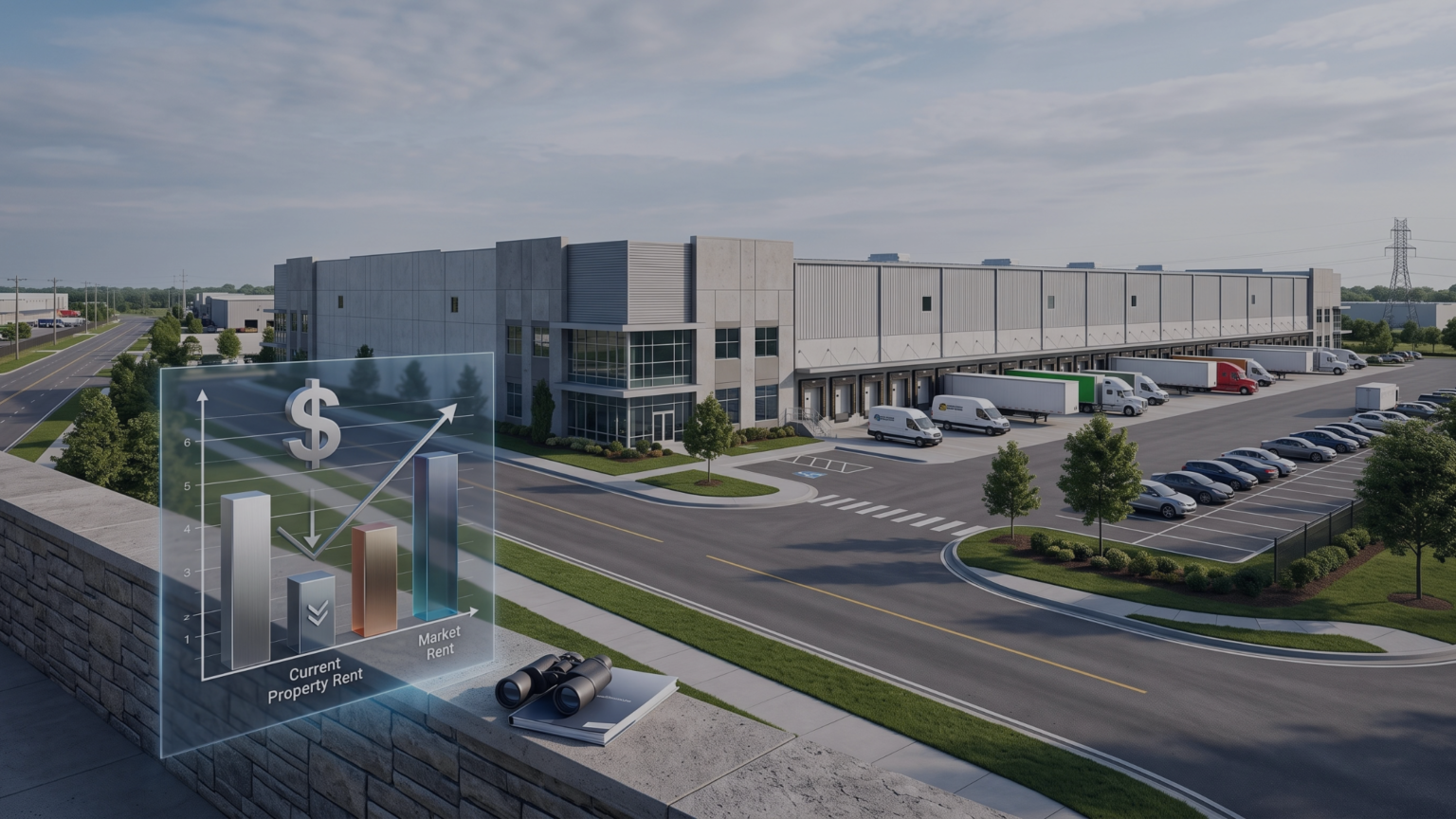
Below market rent can make a CRE investor hesitate, but an industrial warehouse or any other commercial real estate property with lower-than-market rents is not automatically a bad investment.
I frequently hear investors say, “I’m not going to buy that property. It’s got a below-market rent.”
It is an understandable reaction. If a property is collecting less rent than similar properties in the market, it can initially look like a disadvantage.
But when I see below-market leases, I don’t immediately see a problem.
I see potential.
The important part is understanding why the rent is below market, how the leases are structured, when those leases expire, and what the local market can support when the time comes to renew them.
For CRE investors, that context can be much more important than simply looking at today’s rental income.
What Does Below Market Rent Mean?
At its simplest, below market rent means that the rent being paid under an existing lease is lower than what the market may currently support for a comparable property.
This can happen for several reasons.
A lease may have been signed when market rents were lower. A tenant may have negotiated favorable terms. Or the surrounding market may have changed since the lease was originally executed.
Regardless of the reason, the difference between the current rent and potential market rent is something investors should understand.
But it is important not to assume that the difference automatically becomes additional income.
There has to be an opportunity to capture it.
That is where the lease becomes important.
Why Lease Structure Matters
When evaluating a commercial real estate investment with below market rent, one of the first things to understand is the lease structure.
A property’s rental income is based on the agreements currently in place with its tenants. Those agreements determine the rent being paid and can establish when changes to the rent can occur.
If a tenant has a long-term lease, for example, the owner may not have an immediate opportunity to move the rent to current market levels.
That means an investor needs to look beyond the current rental rate.
The question isn’t simply:
“Is the rent below market?”
The better question is:
“When and how can the property potentially capture the market rent?”
That distinction can change how an investor views the opportunity.
When Do the Leases Expire?
Timing is another major consideration.
Suppose you are evaluating a commercial property where the existing rents are below market.
If the leases expire soon, there may be an opportunity to address those rents in the relatively near future, assuming market conditions support higher rates.
If the leases have many years remaining, that potential may be much further away.
The property could still have value, but the timing of any potential income growth becomes an important part of the investment analysis.
This is why lease expiration dates deserve close attention.
A property’s current rent only tells you what the tenant is paying today. The lease schedule can help you understand when the investment may have an opportunity to change.
What Can the Local Market Support?
The next question is what the local market can actually support.
It is easy to look at comparable properties and say, “This property should be getting more rent.”
But investors need to understand whether those higher rents are realistic for the specific property.
Market conditions can vary significantly by location and property type.
An office building, retail center, multifamily property, or industrial warehouse may each have different rental dynamics. Even properties of the same type can have different rental potential based on their location, condition, tenant demand, and other property-specific factors.
That is why market rent should be viewed as a reference point, not an automatic guarantee of future income.
The local market needs to support the opportunity.
Below Market Rent Can Create Potential
This is where the investment story becomes more interesting.
If a property has below market rent and the leases are structured properly, there may be an opportunity to increase income when those leases come up for renewal.
That potential can be valuable to an investor.
Consider a property where existing tenants are paying rents below what the local market may support. If those leases are approaching expiration and the market remains strong, the owner may have an opportunity to negotiate new rental rates.
Again, this is not automatic.
The tenant has to agree to the new terms, market conditions have to support the rental rate, and the property still needs to be competitive.
But the possibility is worth analyzing.
Instead of viewing the current lower rent only as a weakness, an investor can also consider whether it represents future upside.
Today’s Rent Is Only Part of the Investment Story
One of the biggest lessons for CRE investors is that a commercial property should not be evaluated based on one number.
Current rent matters. But so do the lease terms, expiration dates, tenant relationships, market conditions, and future opportunities.
A property with below market rent may initially appear less attractive because the current income is lower. But if the property has leases that are approaching expiration and the local market can support higher rents, there may be another side to the story.
That is why I believe investors need to understand the full picture before deciding that below-market rent is a problem.
Don’t Confuse Potential With a Guarantee
There is an important distinction here.
Below market rent can create potential.
It does not guarantee that rents will increase.
Market conditions can change. Tenants can choose not to renew. A property may face competition. And the market may not support the rental rate an investor expects.
That is why careful analysis is still necessary. The goal isn’t to assume that every property with below market rent has hidden value. The goal is to determine whether the specific property has a realistic opportunity to increase income in the future.
Questions CRE Investors Should Ask
If you’re evaluating a commercial real estate property with below market rent, consider starting with a few basic questions:
- Why are the current rents below market?
- When were the current leases signed?
- When do the leases expire?
- What are the renewal terms?
- What does the local market currently support?
- How competitive is the property?
- When could the owner realistically capture higher rents?
The answers can help you understand whether the current rental rate represents a concern, an opportunity, or simply a factor that needs to be considered as part of the overall investment.
Is Below Market Rent Really a Problem?
Not necessarily.
That is the main point I discuss in the video.
When I hear that a property has below market rent, I don’t automatically eliminate it from consideration. I want to understand the opportunity behind the number. If the leases are structured properly, there may be an opportunity to increase income when renewals occur.
But timing matters.
And the local market matters.
The key is to understand when the opportunity exists and whether the market can support it.
Sometimes today’s lower rent becomes tomorrow’s upside.
For a CRE investor, that can be an important distinction.

Watch the Video
Want to hear my take on the question?
In the short video, I discuss why I don’t automatically see below market rent as a problem and why investors should look at the lease structure, timing, and local market before making a decision.
Watch the video:
https://www.youtube.com/shorts/oHX8RCO-ABw
Evaluating a Commercial Real Estate Investment?
If you’re evaluating a property with below market rent, don’t make the decision based on the current rental rate alone.
Look at the lease. Understand when it expires. Study what the local market can support. Then determine whether there is a realistic opportunity for future income growth.
Have a CRE property you’re evaluating? Let’s talk.
Larry Emmons, SIOR, CCIM
Senior Managing Director | Capital Markets
Newmark
m 248.705.9115 | t 248.447.2707
larry.emmons@nmrk.com
Call Larry to discuss your next CRE investment opportunity.